
Reflective metal
Control glare and reveal scratches, texture, or surface variation.
Machine vision lighting manufacturer
LuxMV helps engineering and sourcing teams connect inspection conditions to lighting geometry, wavelength, optics, controller timing, and integration inputs before a model is treated as final.
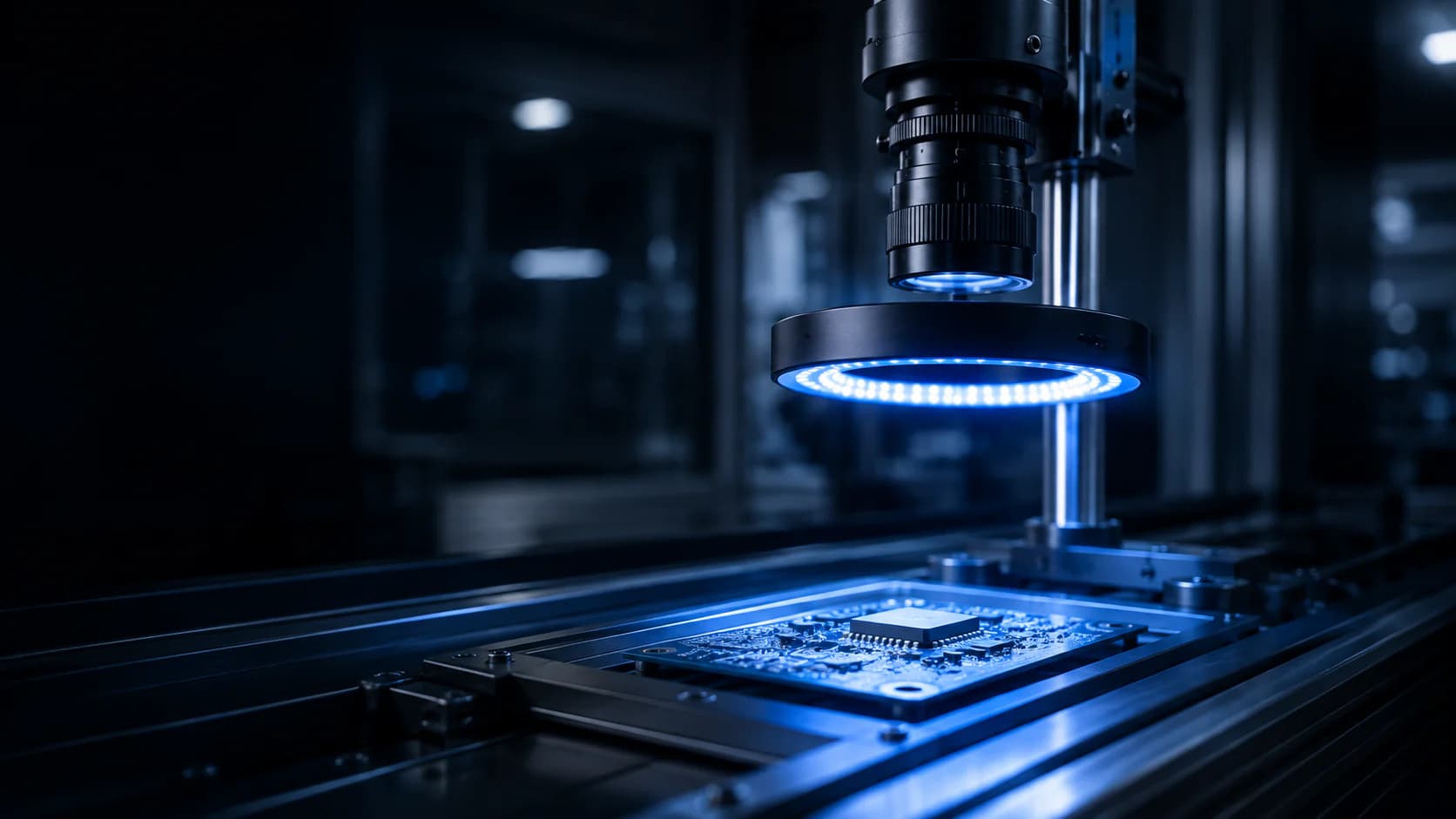
Engineers rarely start with a model number. The selection path moves from the inspection condition to lighting principles, then to an appropriate product family.
Control glare and reveal scratches, texture, or surface variation.
Compare illumination around reflective geometry, components, and inspection access.
Relate line speed, exposure, uniformity, and wrinkle contrast to the inspection setup.
Review lighting context for inspection tasks involving semiconductor components and materials.
Use the catalog to compare the component family first, then confirm the inspection-specific parameters with real sample context.
Ring, bar, coaxial, backlight, line-scan, UV, IR, and SWIR lighting for controlled image contrast.
Application-specific wavelengths, optical structures, housings, and form factors for non-standard inspection tasks.
Fiber-optic illuminators and light guides for localized, microscopic, and space-constrained inspection.
Trigger, strobe, intensity, and multi-channel controllers for repeatable illumination timing.
Telecentric, fixed-focal-length, and macro lens options for dimensional imaging and fine-detail inspection.
Area-scan and line-scan camera options for industrial image acquisition and inspection.
Diffusers, polarizers, mounting hardware, and optical accessories for system integration.
Trust evidence
For industrial buyers, trust comes from product data, usable application references, and clear production or testing context. These routes help verify whether LuxMV fits the next project step.
Review standard builds, custom structures, cabling, drawings, and documentation context.
Testing laboratoryUse sample context and test variables to compare likely lighting and imaging routes.
Quality controlCheck how optical, electrical, thermal, mechanical, and documentation details are handled.
Describe the part, the feature to reveal, and the image outcome the inspection must support.
Evaluate geometry, wavelength, diffusion, polarization, optics, and control against the actual constraints.
Use drawings, product data, sample context, and project details to define an appropriate next step.